Calibrate
Structure how a system holds competing constraints before it acts or answers.

What CONEXUS Builds
CONEXUS develops calibration and optimization architecture, tests it under controlled conditions, and translates selected methods into products.
Structure how a system holds competing constraints before it acts or answers.
Separate measured findings from hypotheses, prototypes, and future applications.
Turn research architecture into bounded products for real human contexts.
Lead Commercial System
Business relationship intelligence for trust-critical moments.
The Automation Ceiling
Business automation can be fast, fluent, and factually correct while still feeling robotic or dismissive when frustration and consequence enter the conversation. Technical competence matters. It does not complete the relationship experience.
Technical success
The relationship failure
Being processed is not the same as being understood.
A two-part trust model
ECHOagent is designed around two dimensions of a trust-critical interaction: perceived intent and demonstrated competence. Warmth without useful capability is unreliable. Capability without human recognition can feel cold.
Warmth / Intent
Are you for me?
Has the system recognized the person and what is genuinely at stake?
Competence / Capability
Can you actually help me?
Can it preserve the facts, exercise judgment, and provide a useful next step?
The ECHOagent Principle
Recognize the person and the human stake. Show accurate attention before delivering judgment.
Deliver grounded judgment, evidence discipline, and a useful next step.
Never fabricate reassurance. Never surrender the facts.
Dual Loyalty
Recognize the ambition, frustration, urgency, fear, or consequence driving the interaction—and treat its significance seriously.
Preserve verified company facts, policy, capability boundaries, and evidence discipline without manufacturing certainty about responsibility.
Believe the significance immediately. Determine responsibility carefully.
The Experience Difference
Illustrative scenario — not a customer case study
A customer believes a Meridian Cloud Readiness Assessment summary is missing the day before an important leadership meeting. The available information does not establish whether an agreed deadline was missed.
Cold competence
A policy-first response establishes the technical boundary and redirects the customer without adequately recognizing why the missing findings matter now.
ECHOagent presence
Recognize that the findings matter before the leadership meeting, acknowledge the urgency, preserve uncertainty about responsibility, and move toward the next useful step.
Technical credibility
ECHOagent is designed to recognize the trust event inside a request, maintain continuity across a session, and prepare structured human handoffs when legal, security, privacy, compensation, or approval boundaries require human authority.
Governance and business context establish a ready posture before live response work.
Server-managed session history keeps follow-up turns connected while session history remains server-controlled.
Authority boundaries can produce a validated handoff packet that preserves the person’s story.
The implemented runtime is supported by container, Azure deployment, UI, staging, and test assets.
The difference between being processed and being understood.
ECHOagent does not choose between human presence and business truth. It is built to hold both.
VIEW TRUST INTELLIGENCE DECK →Four-Arm Evidence
Across 200 independent runs, the full CONEXUS architecture pushed the model farther from its ordinary response pattern than any of the three control conditions. More tokens alone did not reproduce the effect.
That matters because the controlled comparison separates the full architecture from simpler explanations such as a longer exchange or exposure to the visible tokens alone.
What semantic distance means
Think of the model's answers as points on a map. Semantic distance measures how far those answers move away from the usual neighborhood. A higher score means the search reached farther into the measured idea space.
Four controlled conditions
The same divergent-thinking task was repeated across four controlled prompt conditions: 50 independent runs per condition and 200 runs in total.
d = 3.7824
Neutral to CONEXUS
Very large separation between Neutral and CONEXUS in the tested configuration.
p = 0.3612
Neutral vs. token-only
Token-only prompting did not reproduce the CONEXUS effect.
Research and Execution Architecture
Five distinct responsibilities, coordinated around bounded work.
Cyndicate is an actively developed five-agent system built on the Agents Last Exam substrate. It divides calibration, gate authority, subtraction, worker execution, and provenance rather than collapsing them into one role.
Active development spans connectors, completion handling, task data, providers, and evaluators across the ALE substrate.
Calibrates the active agents for the task.
Applies command authority and verifies hard gates.
Removes weak candidates while retaining useful contradictions.
Spawns and terminates bounded workers that execute task actions.
Records provenance alongside the work.
Technology / Research / IP / Optimization
These programs connect calibration architecture, controlled research, patent filings, and strategic elimination across distinct stages of development.
Calibration, governed response behavior, bounded execution, continuity, and provenance-oriented architecture.
Controlled experiments and benchmark programs with defined conditions, measurements, and provenance.
Eight U.S. patent applications spanning calibrated AI, symbolic calibration, provenance, human-AI collaboration, authorship systems, and strategic optimization.
The Forgetting Engine tests strategic candidate elimination under defined budgets as a separate research program.
Intellectual Property / Patent Portfolio
A portfolio spanning calibrated AI, symbolic calibration, provenance, human-AI collaboration, authorship systems, and strategic optimization.
Sequential collaboration, process data, creative authorship, and technical provenance across human-AI systems.
U.S. Patent Application 01
Timed, multimodal human-AI collaboration with sequential orchestration and limited visibility.
Application lineage
63/820,976 → 19/700,312
U.S. Patent Application 02
Structured sequential human-AI collaboration with associated behavioral and process-data generation.
Application lineage
63/822,426 → 19/705,219
U.S. Patent Application 03
Process lineage, structured collaborative telemetry, provenance, and paradox-tolerant runtime governance.
Application lineage
63/825,704 → 19/711,232
U.S. Patent Application 04
Personalized model adaptation, human creative control, and technical provenance for AI-assisted works.
Application lineage
63/828,150 → 19/714,528
U.S. Patent Application 05
Action-level creative provenance and structured measurement of human contribution in AI-assisted creation.
Application lineage
63/828,831 → 19/715,483
Symbolic calibration architectures and strategic optimization methods extending the CONEXUS research program.
U.S. Patent Application 06
ECP / Triadic Symbolic Induction
Triadic symbolic calibration, Nine-Gear sequencing, and Become / Collapse control of exploratory versus convergent model behavior.
Application lineage
63/839,120 → 19/731,083
U.S. Patent Application 07
Symbolic Vector Calibration
Emoji-based symbolic vectors used as compact carriers of calibration structure.
Application number
63/891,100
U.S. Patent Application 08
The Forgetting Engine
Population-based optimization through strategic elimination while retaining structurally promising paradox candidates.
Application number
63/898,911
Products
NAiRTHEX and ECHOform bring the underlying methods into governed reflection, user-directed interpretation, and human context.
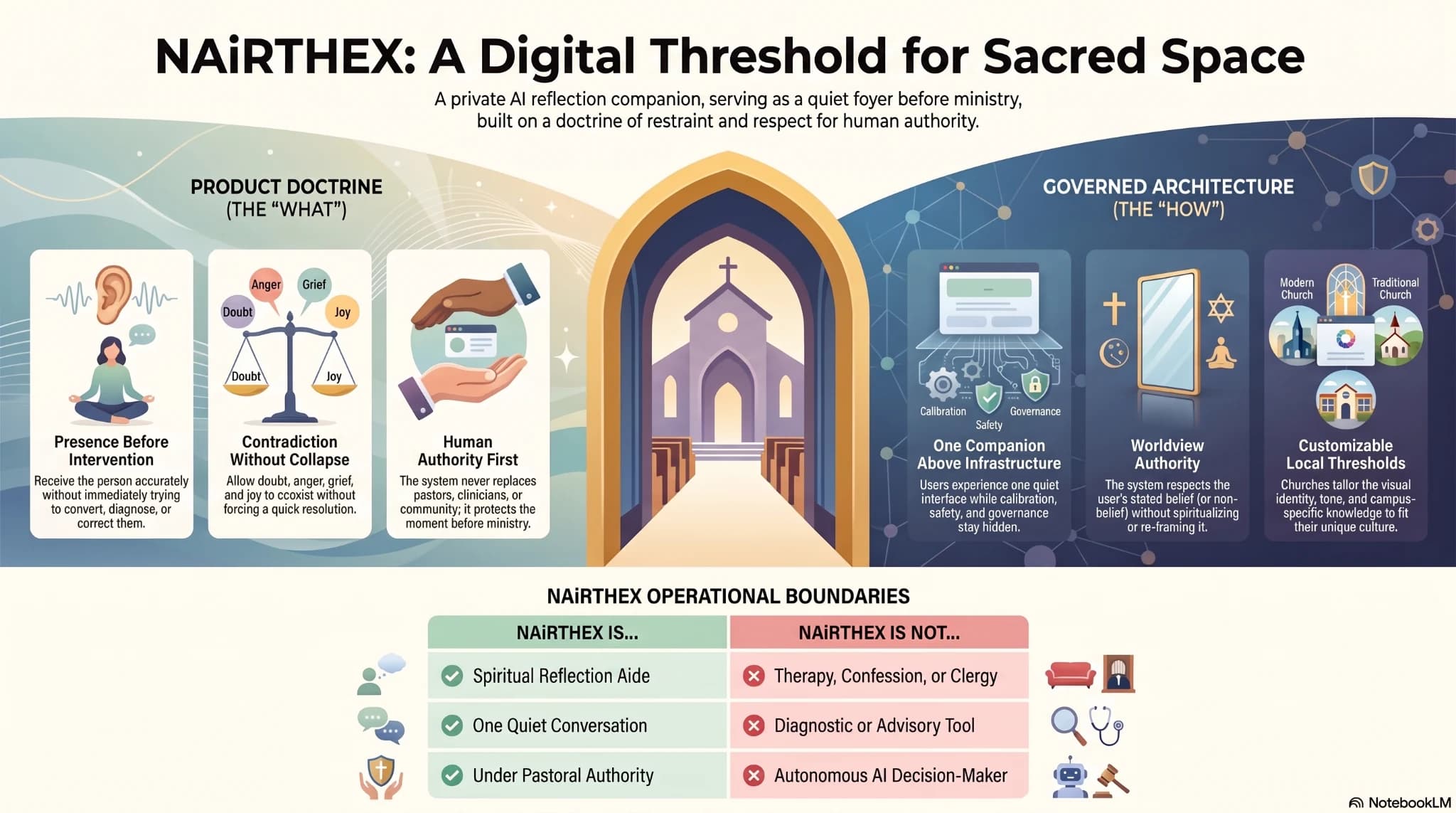
Faith and Reflection
A Digital Threshold for Sacred Space
NAiRTHEX is designed as a reflective threshold shaped by restraint, voice and text, and human pastoral authority.
A private voice-and-text threshold shaped by restraint, governed reflection, and human pastoral context.
Dream Journal and Mirror
Your dream becomes a symbolic reflection. You decide what it means.
ECHOform turns a dream, memory, or written moment into multiple creative perspectives and visual mirror choices, with meaning directed by the user.
Shadow, Light, and Reality perspectives open visual and written paths for user-chosen interpretation.
Founder / Company

Founder & CEO
Inventor of ECP and architect of the Forgetting Engine. Founder of CONEXUS, building calibration, optimization, and provenance systems through controlled experiments and cross-domain computational research.
A founder-led company connecting controlled research, calibration and optimization architecture, provenance discipline, and human-facing products.
“We didn't just build a smarter AI. We built a system that feels the weight of the problem.”
The Refiner
The deeper CONEXUS thesis explores refinement, subtraction, contradiction, and judgment as architectural ideas. The metaphor gives the thesis its visual and conceptual lens.
Experience the Refiner Thesis →Pilots / Partnerships / Funding
Discuss a scoped product or research evaluation.
Start a Pilot Conversation →Explore strategic, research, or technical collaboration.
Discuss a Partnership →Review the evidence, company thesis, and investor overview.
Investor Overview →